Per Unit System
Understand why the per unit system is used, apply it to single- and three-phase networks, handle transformer effects, convert system bases, and solve detailed numerical examples.

Master power system analysis through 20+ hours of hands-on lessons covering per unit systems, load flow, network matrices, symmetrical and unsymmetrical faults, stability, and practical ETAP studies.

Learn the mathematical foundations, numerical solution methods, fault calculations, network modeling, and industry-standard ETAP studies.
Understand why the per unit system is used, apply it to single- and three-phase networks, handle transformer effects, convert system bases, and solve detailed numerical examples.
Classify system buses, derive the Ybus admittance matrix, understand power-flow equations, and solve load-flow problems using Gauss–Seidel and Newton–Raphson methods.
Build a clear understanding of Taylor expansion, Jacobian matrix elements, voltage and angle effects on active and reactive power, and iterative load-flow solutions.
Represent networks using oriented graphs, trees and co-trees, and understand element-node and bus incidence matrices.
Study primitive network matrices, network connection matrices, and the systematic formation and calculation of the Ybus admittance matrix.
Understand fault classifications, phase and earth faults, symmetrical and unsymmetrical faults, open-circuit faults, and the difference between faults and overloading.
Interpret healthy-system and fault phasors, and understand positive-, negative-, and zero-sequence reactance diagrams for different fault conditions.
Understand machine reactance during faults, apply Thevenin equivalents, follow a systematic solution procedure, and work through multiple numerical examples.
Convert unbalanced systems into symmetrical components, construct sequence networks, select equivalent circuits, and solve line-to-ground, line-to-line, and double-line-to-ground faults.
Explore rotor-angle, frequency, and voltage stability and understand the different ways a power system can respond to disturbances.
Build single-line diagrams, assign component ratings, perform load-flow and short-circuit studies, and explore loading categories and bus types.
Practice arc-flash analysis, transient stability, harmonic analysis and filters, PV system simulation, and electrical earthing-grid design using ETAP.
Develop the analytical skills needed for university studies, technical interviews, research, and practical power-system engineering.
Strengthen your understanding of per unit systems, load flow, network matrices, fault analysis, and power system stability through worked examples.
Build confidence in solving power system problems and interpreting the behavior of electrical networks under normal and fault conditions.
Develop practical skills in ETAP studies, including load flow, short circuit, arc flash, transient stability, harmonics, PV, and earthing grids.
Review the key concepts and follow the worked examples with the downloadable course materials.
Revisit per unit calculations, load-flow methods, network matrices, fault analysis procedures, phasor diagrams, and stability concepts.
Follow practical power system studies, from drawing a single-line diagram and entering equipment ratings to performing advanced analyses.
Follow the lessons with subtitles in English, Arabic, Hindi, German, French, and Spanish.
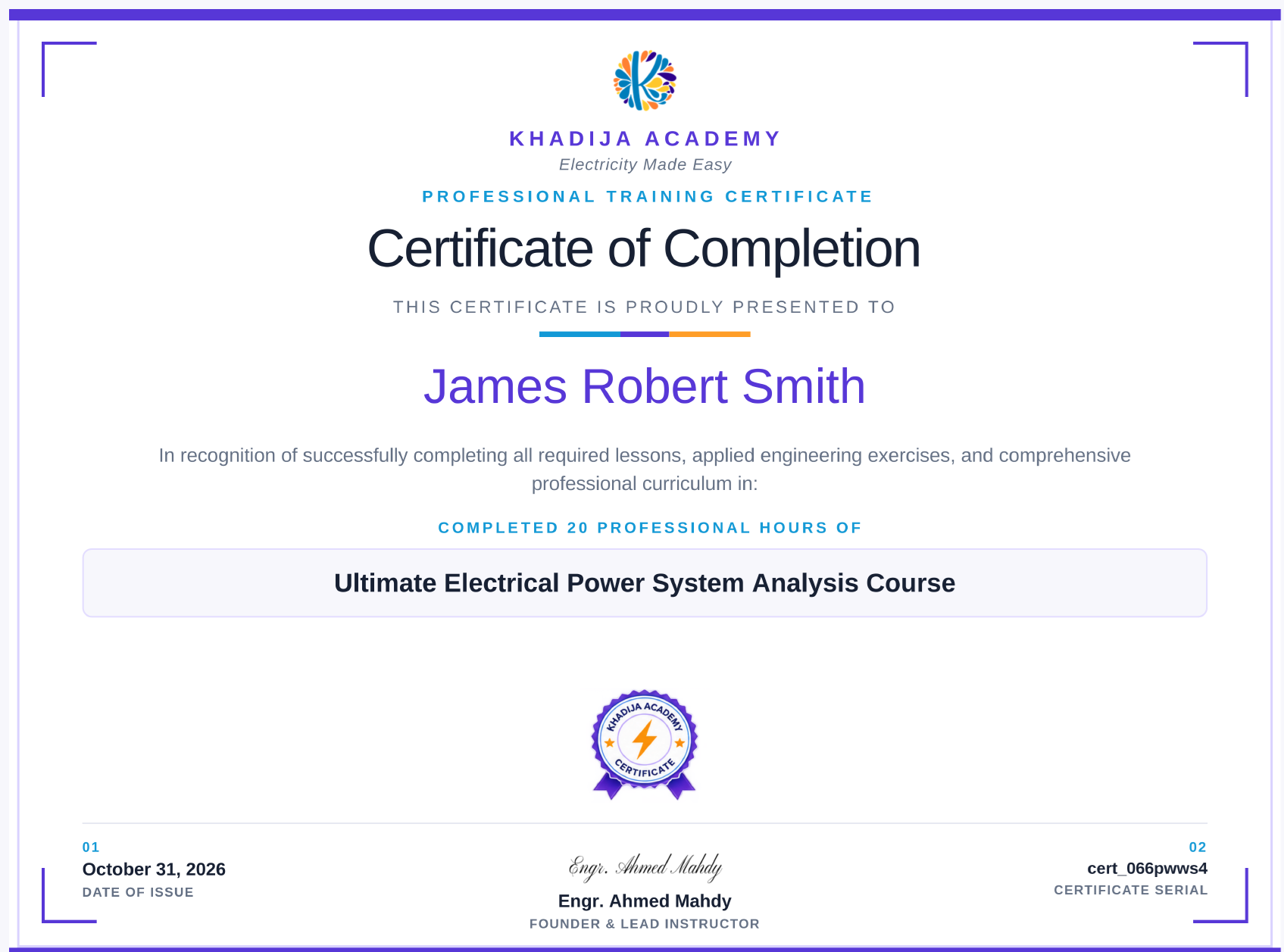
Complete the course according to the platform's requirements and use your certificate to document your power system analysis learning.
Choose a monthly subscription or make a one-time payment for lifetime access.
A flexible option for learners who prefer monthly payments.
Recurring monthly subscription. Cancel anytime subject to the platform's terms.
Pay once and keep access to the complete bootcamp without recurring payments.
One-time payment. Check checkout for applicable access terms.
Honest feedback from students about the course content, clear explanations, and practical power system analysis lessons.

The course was pretty impressive and helpful

Wow! This is one of the Best courses I have taken over the past five years!!

Despite being only three episodes in, I am excited for what’s to come. Every episode so far has left me eager to learn more, a testament to the course’s quality and high level of engagement it promotes.
I highly recommend this Electrical Engineering course to anyone seeking a comprehensive and enjoyable dive into the subject matter. Here’s to the next episodes filled with insight and knowledge!
good experience so far ,lets see how it goes
Exactly what I was looking for. Thank you Sir🙏
World's best Electrical teacher.
excellent course, almost covered the whole topic for my college studies.
Find out more about per unit calculations, load flow, fault analysis, ETAP, and course access.
The course covers the per unit system, load flow analysis, Gauss–Seidel and Newton–Raphson methods, power system matrices, graph theory, symmetrical and unsymmetrical faults, and power system stability.
Yes. You will study bus classification, Ybus derivation, power flow equations, approximate solutions, Gauss–Seidel, Newton–Raphson, and the Jacobian matrix.
Yes. The course explains machine reactance during faults, Thevenin-based symmetrical fault analysis, symmetrical components, sequence reactance diagrams, and step-by-step fault calculations.
Yes. The curriculum includes ETAP lessons on single-line diagrams, component ratings, load flow, short-circuit analysis, arc-flash studies, transient stability, harmonics, harmonic filters, PV system simulation, and earthing/grounding grid design.
Yes. Downloadable PDF course slides are included in the relevant course sections.
Subtitles are available in English, Arabic, Hindi, German, French, and Spanish.
Monthly access is $19.99 per month. Lifetime access is a one-time payment of $97, with no recurring renewal.
Yes. You can progress through the lessons at your own pace and revisit the course materials as needed.
Yes. You can request a refund within 7 days of your purchase.
Build confidence in per unit calculations, load flow, fault analysis, network matrices, stability, and practical ETAP studies.
Explore Course Access OptionsMonthly subscription or one-time lifetime purchase.